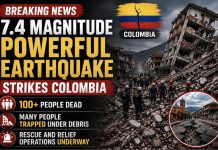

Caracas, Venezuela: Two powerful earthquakes struck Venezuela on Wednesday evening, triggering widespread panic, significant structural damage, and fears of a major humanitarian crisis. The twin quakes, measuring 7.2 and 7.5 in magnitude, shook large parts of the country, including the capital Caracas, and were felt as far away as the Brazilian Amazon region.
According to preliminary reports, the first earthquake, measuring 7.2 magnitude, struck near Yaracuy State. Just 40 seconds later, a stronger 7.5-magnitude quake hit the region, compounding the devastation. Both earthquakes were relatively shallow, increasing their destructive impact on populated areas.
Residents across Caracas rushed out of homes, offices, and commercial buildings as powerful tremors rattled the city. Several structures reportedly collapsed, while emergency services responded to multiple incidents involving trapped residents and damaged infrastructure.
The hardest-hit areas include La Guaira, Chacao, and Baruta, where authorities have reported extensive damage to buildings, roads, and public utilities. Power outages affected large sections of the country, disrupting communication networks and emergency response efforts. Schools were closed as a precaution, and airport operations were temporarily suspended while officials assessed potential damage to critical infrastructure.
The United States Geological Survey (USGS) issued a Red Alert following the earthquakes, warning of a high likelihood of casualties and extensive economic losses. Preliminary USGS impact models indicate a 40–44 percent probability that fatalities could range between 10,000 and 100,000 people. However, experts emphasize that these figures are projections based on disaster modeling and should not be interpreted as confirmed casualty numbers.
Emergency management agencies have launched search-and-rescue operations in affected regions, while hospitals have been placed on high alert to treat injured residents. Authorities are urging citizens to remain cautious, avoid damaged buildings, and follow official safety instructions.
Adding to concerns, more than 20 aftershocks have been recorded since the initial earthquakes, raising fears of further structural collapses and complicating rescue efforts. Seismologists continue to monitor the situation closely as aftershock activity remains elevated.
Videos circulating on social media show scenes of panic, damaged buildings, and residents gathering in open areas after fleeing their homes. Authorities have urged the public to rely on verified information and avoid spreading unconfirmed reports.
As rescue teams continue their operations, the full extent of the disaster remains unclear. Government officials are expected to provide updated assessments in the coming hours. For now, Venezuela faces one of its most significant seismic emergencies in recent years, with the nation anxiously awaiting confirmation of casualties and damage estimates.