

@ Vikash Sharma | Sr Journalist
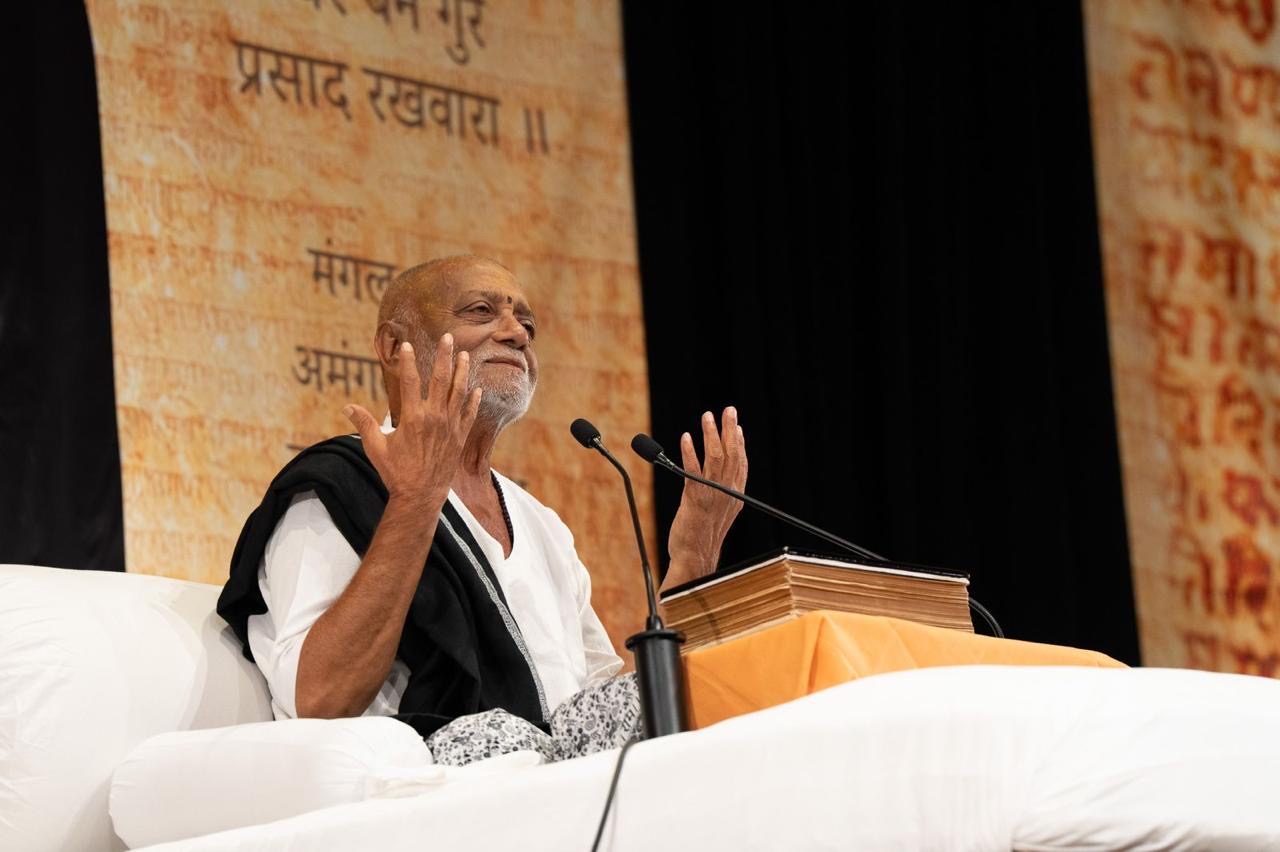
Cambridge, Massachusetts, August 15 — Well-known Ramayana exponent Morari Bapu inaugurated a nine-day discourse at Sanders Theatre, Harvard, on Saturday, running through to 23 August Bapu has named this recital ‘Manas Guru Prasad’.
The Katha started as India marked its 80th Independence Day, with the Ramcharitmanas of Goswami Tulsidas opening at one of the world’s most celebrated universities. The moment carries a significance that extends well beyond Harvard’s gates. Bapu’s Katha commenced with warm welcomes from Hitesh Hathi – Executive Director, Lakshmi Mittal and Family South Asia Institute, Harvard University.
Prof Diana Eck, Faculty Director, The Lakshmi Mittal and Family South Asia Institute at Harvard University, said, “Perhaps Ram, Sita and Lakshmana were the primordial pilgrims. Their 14-year journey of vanvas, from Ayodhya through Prayag, Chitrakoot, Panchavati and Kishkindha to Setu at Rameshwaram, unfolded across the great stage of India itself. As they travelled, these places were transformed into sacred sites, and pilgrims have followed their footsteps ever since. Their journey also became the landscape of Ramlila, extending beyond India to Thailand, Indonesia and Cambodia. The Ramayana, therefore, is not simply a story or a map—it is a living landscape, one into which Tulsidas and Morari Bapu invite all of us today.”
In a profound gesture of greeting, Lord Dolar Popat said, “With great joy, he spoke in the presence of my Guru. There is a beautiful synergy in this occasion. Harvard’s motto is Veritas, which resonates deeply with the values of Satya, Prem and Karuna. It is this shared spirit that makes this gathering at Harvard so meaningful. And he invited everyone to join for prasad – lunch / dinner every day.”
Around Bapu gathered a distinguished delegation of kathakars, scholars, musicians and artists, alongside international academics — including several members who had never before travelled outside India. Within the nine days of the Katha, the organisers are convening a three-day scholarly talk from 16 to 18 August. The backdrops are beautiful showing Valmiki as The Origin, Tulsi the bridge to the people Vishnu the preserver and Tribhuvana as The Continuation.
These three chaupais from the Ramcharitmanas have been taken as the central theme of the Katha:
‘गुर प्रसाद सब जानिअ राजा । कहिअ न आपन जानि अकाजा ॥’
‘मख रखवारी करि दुहुँ भाईं । गुरु प्रसाद सब बिद्या पाईं ॥’
‘सहित समाज तुम्हार हमारा । घर बन गुर प्रसाद रखवारा ॥’
On 19 August, Tulsi Jayanti, the birth anniversary of Tulsidas, will be honoured at the theatre with the Tulsi, Vyas, Valmiki and Ratnavali awards, presented for the first time outside India. As the organisers have put it, this is not India’s story being explained to the world — it is India’s story being told to the world, in its own voice, from the Vyaspeeth.
Bapu initiated the Tulsi Jayanti program in 2010 as part of the observance, to recognise those who have dedicated their lives to preserving, interpreting and carrying forward the tradition of Ram Katha and the Ramcharitmanas. Each year since, the Tulsi Janmotsav has brought together saints, scholars, kathakars and other distinguished contributors at Talgajarda in Gujarat. In 2026, the tradition takes a historic step beyond India for the first time — the Tulsi Jayanti programme travels abroad, to the USA, carrying Goswami Tulsidas’s legacy to a global audience.
The delegation includes, to name a few: Pujya Maa Mandakini Ji (Ayodhya), Pujyashree Bhupendrabhai Pandya Ji, Dr. Shri Pundrik Goswami Ji (Vrindavan), Shri Uma Shankar Sharma), Jagatguru Shri Ramkamaldas Vedanti Ji Maharaj (Varanasi), and many more.
The organising team, along with Diana Eck, a renowned scholar of Religious Studies, opened proceedings with welcome remarks ahead of the recital.
Bapu, renowned for spreading the message of “Truth, Love and Compassion” worldwide, said, “ This katha is being held in Savan maas, in the context of Tulsi Jayanti. What was lit today by the sadhus was not gyan deep, it was prem jyoti. We have come here to perform an Adhyatma Anushthan — Satya, Prem aur Karuna hi Tribhuvana sutras par bolne aaye hain(We have come to speak on the Tribhuvana Sutras of Satya, Prem and Karuna). The issue today is that we do pujan of the sadguru, rather than of his saat (his words). Katha at Harvard happened because of Paavan’s efforts.”
Bapu added, Laukik, alaukik chhod kar maulik ho jaaye (Let us leave behind the worldly and the otherworldly, and become truly authentic). — that is what I wish for all of us here. On the occasion of India’s Independence Day, he congratulated everyone and said, “My Pranaam”—expressing his respectful salutations to the Indian flag. He added, “Protocol says we salute the national flag, but for the Indian flag, pranam karne ka mann karta hai.”
Paavan Popat OBE, of the organising team for this Ram Katha, said, “For nine days, the world’s oldest recital traditions and one of its greatest centres of learning will sit in the same room and listen to each other. Bapu has carried this story to Kailas Manasarovar, the Vatican, the United Nations and Cambridge. What moves me most is not the stage but the people: sadhus and scholars from Chitrakoot, Ayodhya and Varanasi, some of whom have never left India, walking through the gates of Memorial Hall, Harvard University with the Ramcharitmanas in their hands. It’s a time for all those present and watching live to reflect and enjoy the moment..”
Harvard is one of the world’s oldest and most distinguished universities. Rabindranath Tagore, India’s first Nobel laureate, lectured at Harvard in 1913 on Indian philosophy and the Upanishads. Economist Amartya Sen, also a Nobel laureate, has taught at Harvard for decades. Sanders Theatre itself, within Harvard’s Memorial Hall, has heard Winston Churchill, Martin Luther King Jr. and T.S. Eliot address its audiences.
Bapu has offered more than 980 Kathas in over 900 locations worldwide, including the Vatican, the United Nations Headquarters in New York, and the University of Cambridge in 2023. Harvard now joins that list of illustrious locations. No participant in the India delegation was paid to take part; travel, stay and meals for the full group were funded entirely by charitable foundations.
About Morari Bapu
Morari Bapu is a renowned exponent of the Ramayana and has been reciting Ram Kathas for over sixty years throughout the world. The overall ethos of his Katha is universal peace and spreading the message of truth, love, and compassion. While the focal point is the scripture itself, Bapu draws upon examples from other religions and invites people from all faiths to attend the discourses. The remarkable journey of reciting the Ram Charita Manas (a popular version of Ramayana written by Goswami Tulsidas) began in front of three village folk when Bapu was fourteen and has now taken him to all corners of the world, from all major cities and pilgrimage sites in India to countries like Sri Lanka, Indonesia, South Africa, Kenya, United Kingdom, United States, Brazil, Australia, Israel, and Japan, drawing millions in audiences. Bapu has often gone beyond stereotypes, holding Ram Kathas for sex workers, transgenders, and those living on the margins of society. He has also been in the forefront in providing aid to any area that has been disaster-hit, whether within India or countries abroad like war-torn Ukraine.